The questions behind the switch to hydrocarbon refrigerants.
Facility managers, technicians, and procurement teams are all asking versions of the same 25 questions. Plain answers, each linked to the page with the detail. Updated as new questions reach engineering.
Regulation and timing
Q1What is happening to R-22, R-410A, and R-404A?
They are being regulated out on a schedule. US R-22 production and import ended in 2020. HFC phase-down steps began in 2022 under the AIM Act in the US, with the Kigali Amendment and EU F-gas rules driving the same direction internationally. Energy costs and AC demand are both climbing while the refrigerants those systems run on lose their supply.
Background: what low-GWP means.
Q2What does GWP mean, and why does it decide the transition?
Global Warming Potential is the warming effect of a gas relative to carbon dioxide over a 100-year window. CO₂ is the baseline at 1. The synthetic refrigerants in service today range from about 1,430 (R-134a) to 3,922 (R-404A). Every Eco Kold blend carries a GWP of less than 1.
See every refrigerant on one scale: performance comparison.
Q3Is a "low-GWP" refrigerant the same as GWP under 1?
No. A 700-GWP refrigerant is a real improvement over a 2,088-GWP one, but "low" is doing a lot of work in that comparison: a kilogram leaked still carries hundreds of kilograms of CO₂-equivalent. Hydrocarbon blends sit at the floor of the scale, matching CO₂ itself.
Q4Do I have to replace equipment to meet the new GWP thresholds?
Not with a drop-in blend. Hundreds of millions of refrigeration and AC systems are already installed in restaurants, offices, and industrial facilities. Eco Kold blends are engineered to match the pressure curve, temperature glide, and oil compatibility of a specific legacy refrigerant, so the transition is a recharge into the equipment you already own. Two exceptions under US EPA SNAP: split-system air conditioners and heat pumps, and vehicle air conditioning.
What an HCR is
Q5What is a natural hydrocarbon refrigerant (HCR)?
A refrigerant made from hydrocarbons rather than fluorinated synthetic gases. Eco Kold HCR is a line of five engineered hydrocarbon blends, each a direct drop-in replacement for a high-GWP synthetic refrigerant, with a GWP under 1 and zero Ozone Depletion Potential.
Q6Which Eco Kold blend replaces which legacy refrigerant?
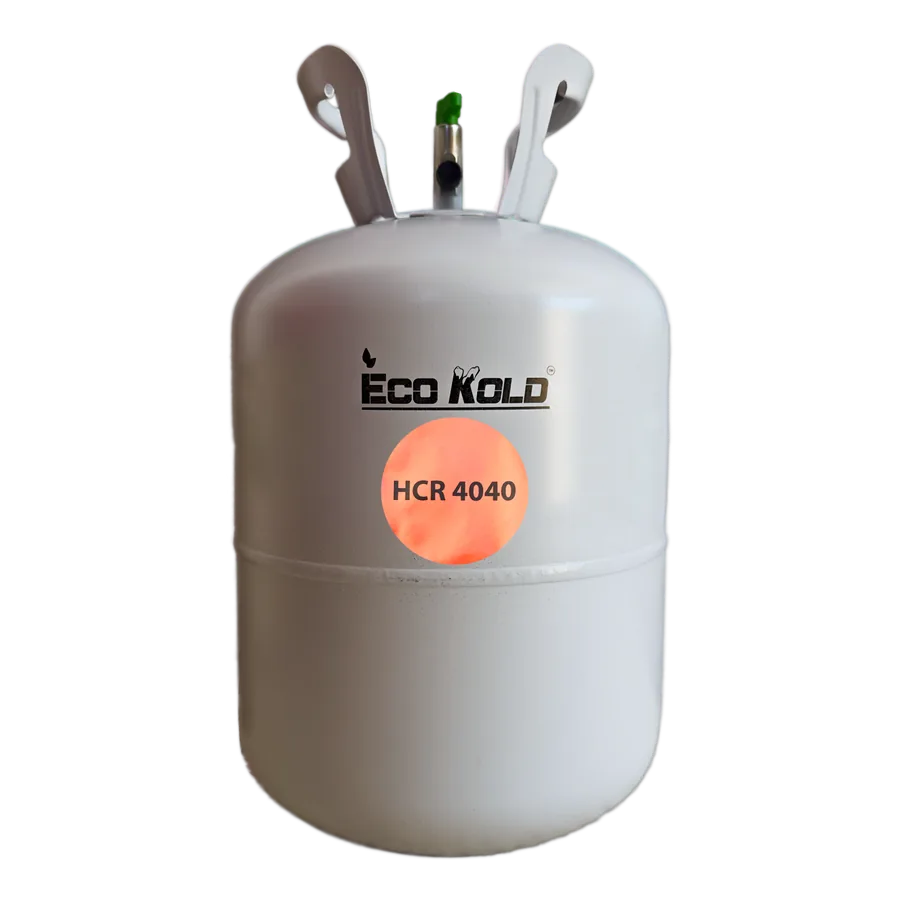
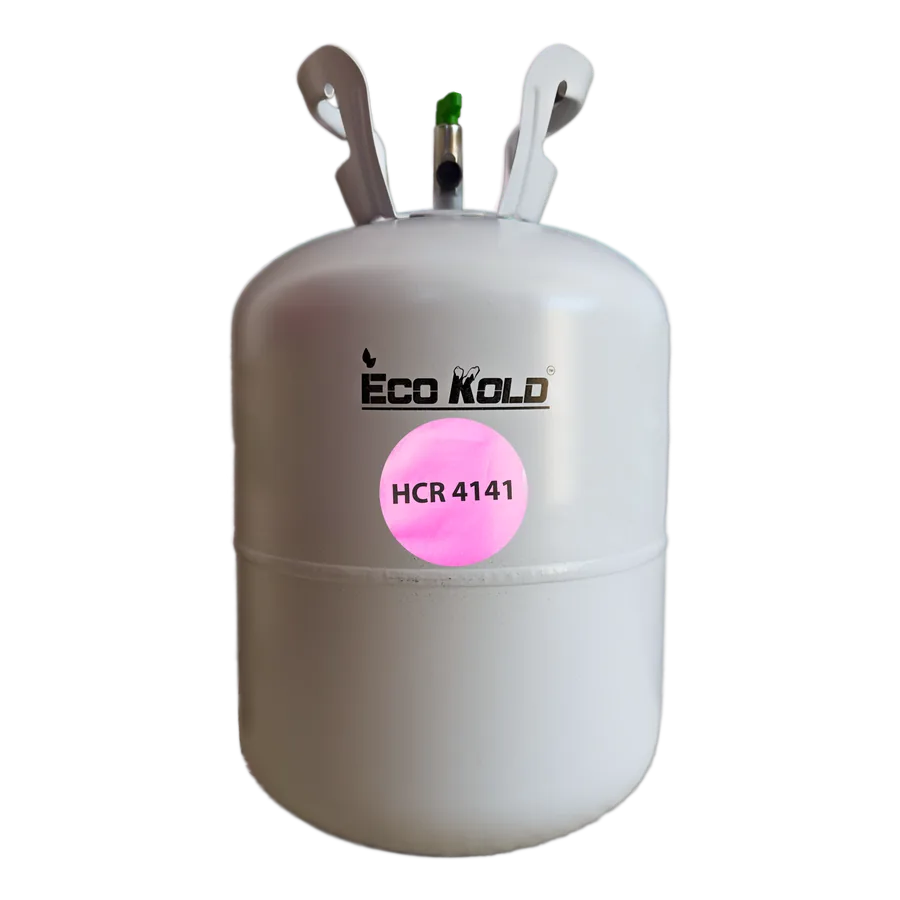
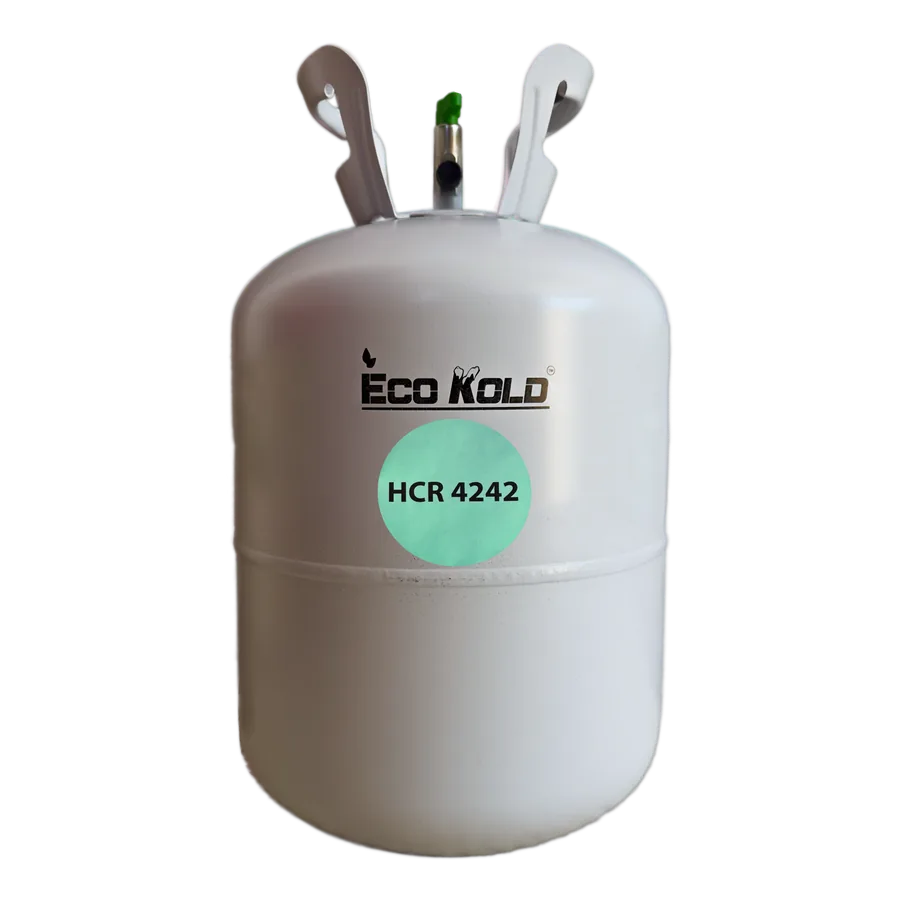
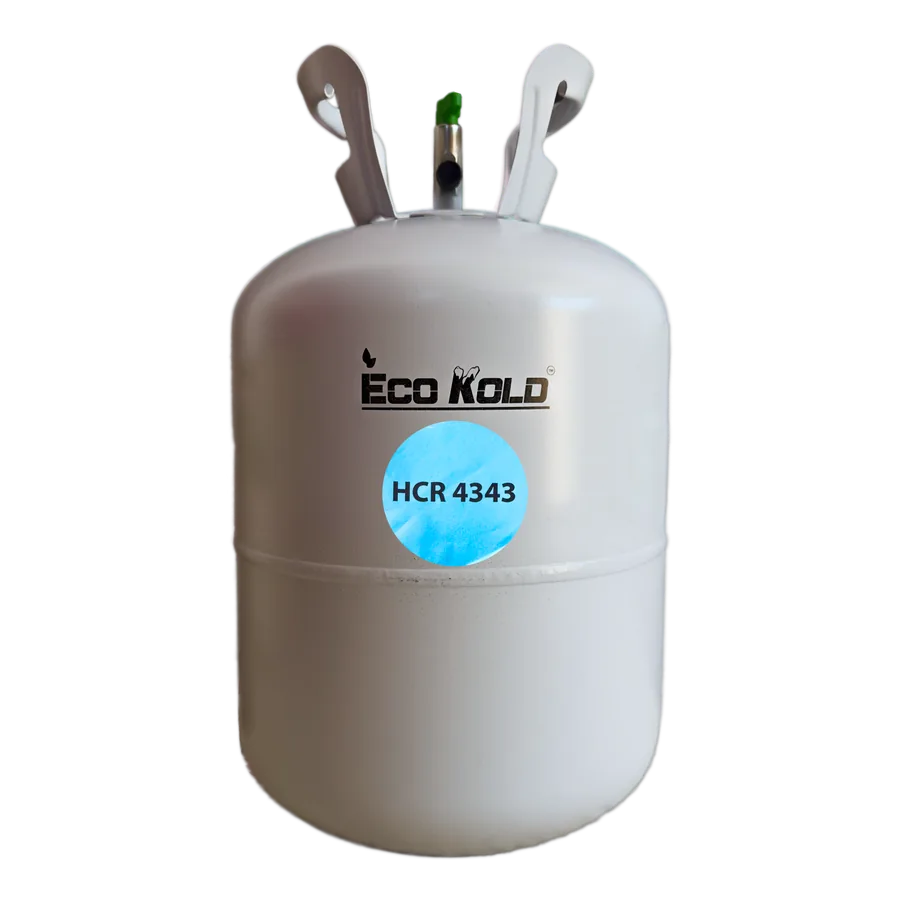
HCR 4040 replaces R-404 and R-513 (commercial refrigeration, low- and mid-temp). HCR 4141 replaces R-410A and R-32 (AC, not split-system retrofits). HCR 4242 replaces R-22, R-407, R-507, R-438, R-448, and R-449 (legacy systems). HCR 4343 replaces R-134 (chillers, cold-chain, industrial). HCR 4343A replaces R-134A (chillers, transport).
Not sure what is in the system? Use the blend finder.
Q7How does a hydrocarbon blend drop into a system built for a synthetic gas?
Each blend is matched to the duty point of the gas it replaces: pressure curve, temperature glide, and oil compatibility. The blends run with mineral oil, POE, and alkylbenzene; HCR 4242 runs on the oil already in an R-22 system. Same compressor, same evaporator, same line set.
Field reference: temperatures and pressures.
Q8Why does an HCR system need so much less refrigerant?
Hydrocarbon blends carry about 65% less charge weight than the synthetic refrigerant they replace. A typical recharge is 25 to 30% of what came out. Less mass in the system means less to leak, less compressor strain, and a smaller inventory subject to F-gas reporting.
Safety and certification
Q9Are hydrocarbon refrigerants flammable, and is that safe?
Yes, they are flammable. Every Eco Kold blend is classified A3 under ASHRAE 34, the same class as propane (R-290) and isobutane, which have been used safely in industrial cooling for decades. Charge limits follow IEC 60335-2-89 and local code, and installation is by certified hydrocarbon technicians only. A hydrocarbon leak is a local fire-safety consideration handled by code; an HFC leak is a multi-decade climate event.
Safety Data Sheets are on every blend page.
Q10Who is allowed to install Eco Kold?
A certified hydrocarbon-refrigerant technician. The training is the same as for R-290 propane retrofits, and most modern HVAC technicians in the EU and Latin America already hold it, with a growing number in North America. Eco Kold maintains a directory of certified installers and matches one to your region with every quote.
Q11What tools does a technician need?
Nothing exotic. A standard recovery machine, vacuum pump, scale, manifold gauges, and PPE. The one addition is a hydrocarbon leak detector, which has the same form factor as a halide detector and is calibrated for hydrocarbons.
Full procedure: installation guide.
Q12Is Eco Kold EPA SNAP listed in the United States?
Not yet. Status varies by blend: HCR 4141 is submitted and pending a final ruling; HCR 4040, HCR 4343, and HCR 4343A are submitted and under review; HCR 4242 is not submitted and is not available for sale in the United States. Approved end-uses and availability vary by country. Every order includes the current SNAP submission status.
Q13Will day-to-day operation change for my staff?
No. Operation is identical to the current system and needs no new operator training. Only installation and service require a certified hydrocarbon technician. Keep retrofitted units away from strong direct heat and open flame, as standard hydrocarbon practice.
The retrofit itself
Q14What does a retrofit actually involve?
Inspect the system, recover the legacy refrigerant into a certified reclaim cylinder, evacuate to 500 microns or lower and hold the vacuum to confirm no leaks, recharge with the matching HCR blend by weight, sticker the unit, and verify pressures. It is the same procedure as any refrigerant service, with no compressor, evaporator, or expansion-valve change.
Q15How long does a retrofit take?
A typical commercial AC retrofit is a weekend job. Multi-unit cold-storage estates are staged across service windows so the site never goes off-line. Each quote includes the project schedule for your equipment list.
Commercial detail: how a commercial retrofit lands.
Q16Can I top off or mix Eco Kold with the refrigerant already in the system?
Never. Mixing damages performance. Recover the old refrigerant completely first, then charge with Eco Kold.
Q17What happens to the old refrigerant?
It is recovered by a certified technician and sent to an EPA-approved reclaim facility. It is never vented.
Q18Does a refrigerant retrofit void my equipment warranty?
Refrigerant swaps do not void most manufacturer warranties, but confirm with your unit's manufacturer if it is still under warranty.
Q19Which systems are not candidates?
Centrifugal compressors. Eco Kold is not recommended for them. Everything else in the five-blend map is a candidate, subject to the certified installer's inspection.
Cost, savings, and reporting
Q20What does a retrofit cost compared to replacing equipment?
A representative commercial AC retrofit costs less than 10% of equivalent equipment replacement, and the system stays on a GWP under 1 charge for the rest of its life. Quotes are single-line: cylinder pricing by weight plus a certified installer in your region.
Q21How much energy will I save?
Eco Kold publishes up to 50% lower energy use, with the largest gains on comfort-cooling retrofits such as HCR 4141 replacing R-410A. Independent field measurement is underway and verified results are published the day they clear. Site-specific projections are included with every quote.
How we measure: on the customer's electric bill.
Q22How does a retrofit show up in Scope 1 and Scope 2 reporting?
Both ledgers move at once. Scope 1: refrigerant leaks, typically 3 to 8% of inventory per year on a commercial estate, drop from thousands of kg CO₂-equivalent per kg leaked to near zero. Scope 2: purchased electricity drops in line with the audited kWh reduction. Every order includes a project-specific carbon-equivalent reduction calculation.
Worked example: sustainable cooling programs.
Q23What documentation comes with an order?
The GHS-formatted Safety Data Sheet, the EPA SNAP submission status, the IEC 60335-2-89 compliance statement, the CE / UKCA certificate, and a project-specific carbon-equivalent reduction calculation. RFP packages are available on request.
Library: documents.
Q24How do I get a quote, and what do you need from me?
Facility type, the equipment make and model list, the refrigerant in the system today, total charge, the service window you can offer, and your region. A commercial quote comes back in one business day with blend fit, cylinder pricing by weight, a certified installer, and audit scope.
Q25Who makes Eco Kold?
BHCR Hq, which has engineered hydrocarbon refrigerants in Delaware and Panamá since 2009. Eco Kold is the line shipping today: five blends refined through a decade of Panamanian and Caribbean installations.
Longer reads: a step-by-step retrofit guide, how safe hydrocarbon refrigerants are in real systems, and whether a commercial AC is ready for the switch.