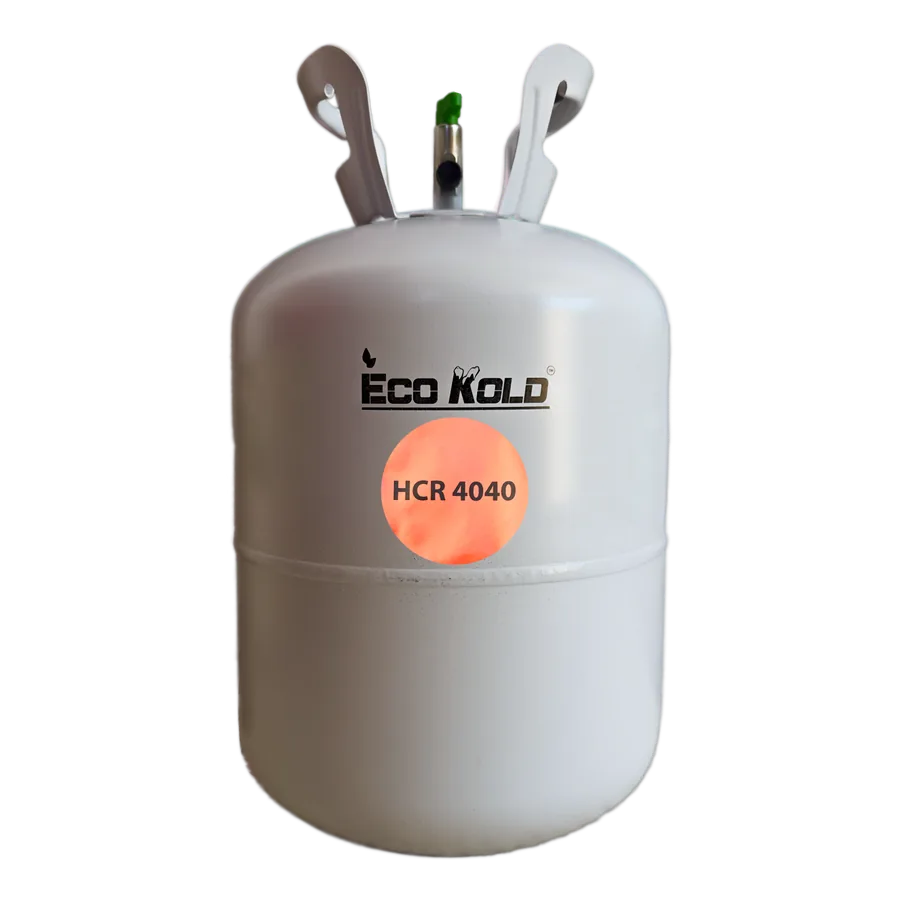
The largest single Scope 1 reduction available to most cooling estates.
For procurement and sustainability teams managing refrigerant inventories and carbon-footprint targets. Switching from a high-GWP (global warming potential, how much a gas warms the planet vs CO2) HFC to a GWP <1 hydrocarbon retires the F-gas line from your Scope 1 ledger and reduces Scope 2 electricity at the same time. One project, two ledger reductions.
How a refrigerant retrofit lands on the carbon report.
Most facility-level decarbonization projects move one ledger at a time. A refrigerant retrofit moves both Scope 1 (direct emissions, including refrigerant leaks) and Scope 2 (purchased electricity) at the same time. The dual effect is unusual: most teams underestimate the combined impact.
Refrigerant inventory drops to near-zero CO₂e
Every kg of legacy refrigerant in the system carries hundreds to thousands of kg of CO₂-equivalent on the balance sheet, sized to expected annual leak rates (3–8% typical). Replacing the charge with HCR (GWP <1) drops that line to functionally zero.
Electricity consumption drops 30–65%
The same retrofit reduces compressor work, current draw, and kWh consumption. The reduction is field-measured and verifiable in your own subsequent utility billing, with an independent audit in progress. The Scope 2 line in your carbon report drops accordingly.
Documentation built into the project
The audit deliverables (Powersight CSVs, before/after kWh logs, refrigerant-substitution PDF) provide the documentation a sustainability auditor needs. Eco Kold can also provide the GWP, ODP, and SDS supporting evidence on request.
What "GWP <1" actually means on your refrigerant inventory.
A facility-level refrigerant inventory is normally reported in CO₂-equivalent units. Multiply each refrigerant's mass by its GWP. Here's what that looks like across the four most common HFCs vs the Eco Kold replacements.
100 kg of refrigerant on inventory · CO₂e impact
| R-404A · GWP 3,922 | = 392.2 tonnes CO₂e |
|---|---|
| R-410A · GWP 2,088 | = 208.8 tonnes CO₂e |
| R-22 · GWP 1,810 | = 181.0 tonnes CO₂e |
| R-134a · GWP 1,430 | = 143.0 tonnes CO₂e |
| Any Eco Kold HCR · GWP <1 | = 0.1 tonnes CO₂e |
Lifetime impact · with leakage assumption
For a 50-unit supermarket cooling estate on R-404A (typical inventory ~250 kg), assuming an industry-average 5% annual leak rate:
Annual Scope 1 from refrigerant alone: 12.5 kg × 3,922 GWP = ~49 tonnes CO₂e/yr.
Same estate on HCR 4040: 12.5 kg × 1 GWP = 0.012 tonnes CO₂e/yr on the refrigerant-leak line.
The electricity-side Scope 2 reduction (up to 50% on top of the F-gas elimination) is additional.
How a sustainability team should evaluate this.
For sustainability teams new to refrigerant procurement, this is the practical four-question framework that gets to a quote-ready brief.
What's in the refrigerant inventory today?
Sum of all installed refrigerant across the cooling estate, grouped by gas type. Most facility teams already have this for F-gas reporting purposes. If not, the data sits in the maintenance log or with the HVAC contractor of record.
What's the annual leak rate?
Estimated or measured. Typical commercial cooling estates average 3–8% per year. The combination of installed inventory × leak rate × GWP is the annual Scope 1 contribution from refrigerants alone.
What's the equipment age profile?
Retrofits make most sense on equipment with 5+ years of operating life remaining. If the cooling estate is 70%+ near end-of-life, an HCR-charged replacement strategy may make more sense than retrofitting the existing fleet.
What's the audit appetite?
Self-reported reduction vs. third-party-audited reduction. For ESG reporting, scope-3-influenced procurement, or external sustainability claims, audited numbers are the right call. Eco Kold coordinates the audit; the cost rolls into the project.
Eco Kold ships sustainability documentation alongside the refrigerant.
Every order includes the GHS-formatted Safety Data Sheet, the EPA SNAP submission status, the IEC 60335-2-89 compliance statement, and a project-specific carbon-equivalent reduction calculation. For RFPs, we provide tailored Scope 1/2 substitution analysis for the specific equipment list under quote.
Scope 1, Scope 2, and the documentation that ships with your project.
How a refrigerant retrofit lands on the carbon ledger, what the audit deliverables include, and how pilots scale to estate-wide deployment.
How much Scope 1 emission reduction does a refrigerant retrofit deliver?
A retrofit from R-404A to HCR 4040 cuts CO₂-equivalent emissions to under 1 GWP per kilogram of refrigerant on the inventory, down from R-404A's 3,922. For a representative 50-unit supermarket cooling estate (~250 kg of R-404A on inventory, 5% annual leak rate), that translates to ~49 tonnes CO₂e/yr eliminated from Scope 1 attributable to refrigerants alone.
Are Eco Kold blends listed in BREEAM or LEED frameworks?
Eco Kold refrigerants qualify under BREEAM Pol-1 (Impact of Refrigerants) and LEED-EBOM Energy and Atmosphere prerequisites for low-GWP refrigerants. We provide GWP, ODP, and SDS supporting documentation, plus a project-specific refrigerant-substitution analysis suitable for credit submission.
What documentation comes with a sustainability retrofit project?
Every order includes the GHS-formatted Safety Data Sheet, the EPA SNAP submission status, the IEC 60335-2-89 compliance statement, and a project-specific CO₂-equivalent reduction calculation. For RFPs, we provide tailored Scope 1/2 substitution analysis for the specific equipment list under quote.
Can we run a pilot retrofit before estate-wide deployment?
Yes. Eco Kold supports pilot deployments on a single unit or small cluster, with optional third-party Powersight audit documentation, before approving wider rollout. This is the standard procurement-friendly path for sustainability teams evaluating refrigerant substitution at scale.
Does refrigerant choice affect Scope 2 emissions too?
Yes. The same hydrocarbon retrofit that eliminates the refrigerant-leak Scope 1 contribution also reduces compressor work and electricity consumption by up to 50%. That Scope 2 reduction stacks on top of the Scope 1 elimination: one project produces both ledger improvements.
Have a system running on R-22, R-410A, R-404A, or R-134a?
Send us the equipment make, model, and current refrigerant. We'll match the right Eco Kold blend, quote pricing, and connect you with a certified installer in your region, usually within one business day.