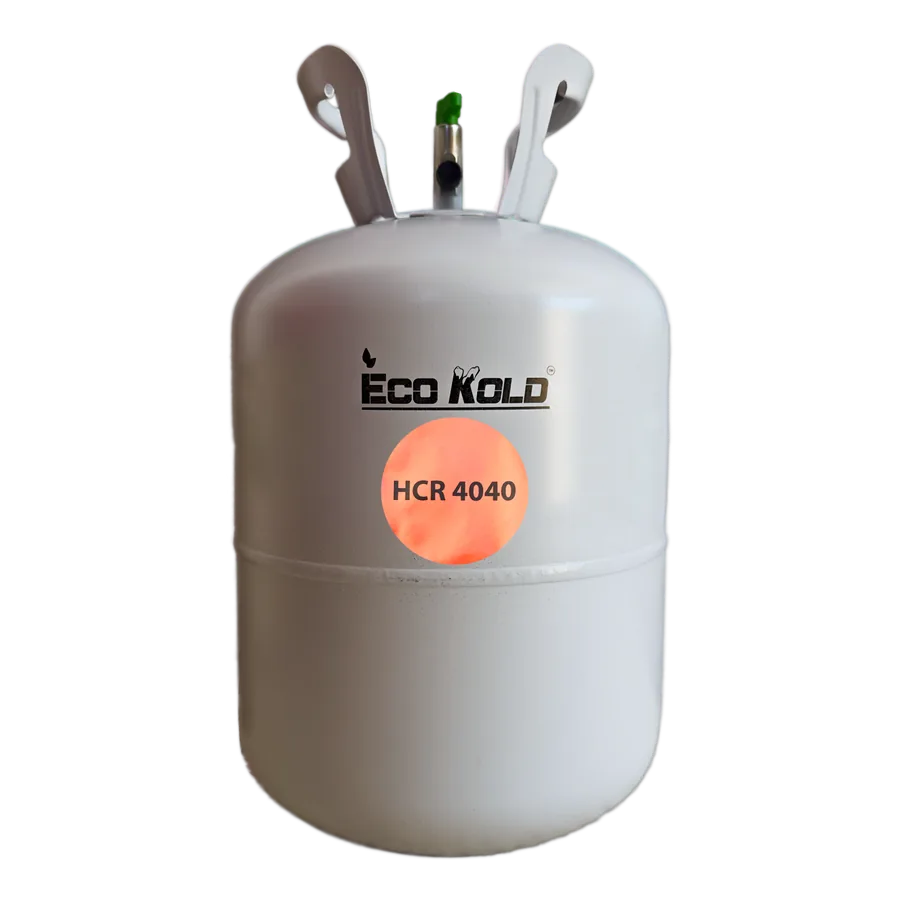
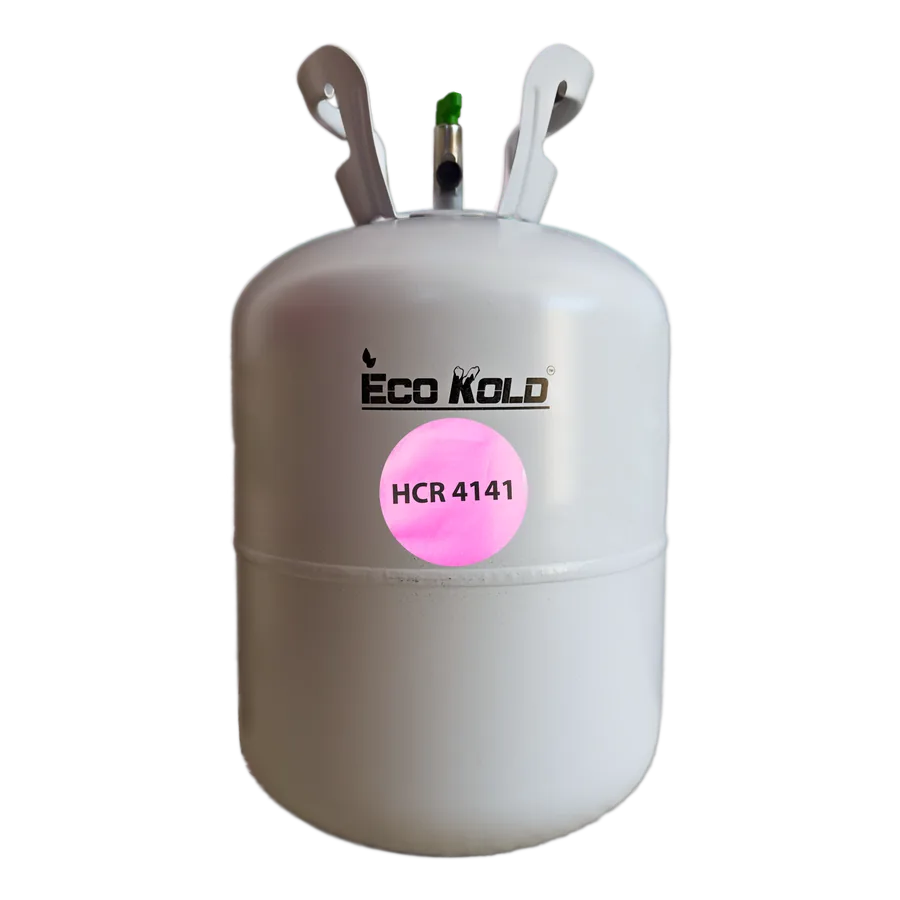
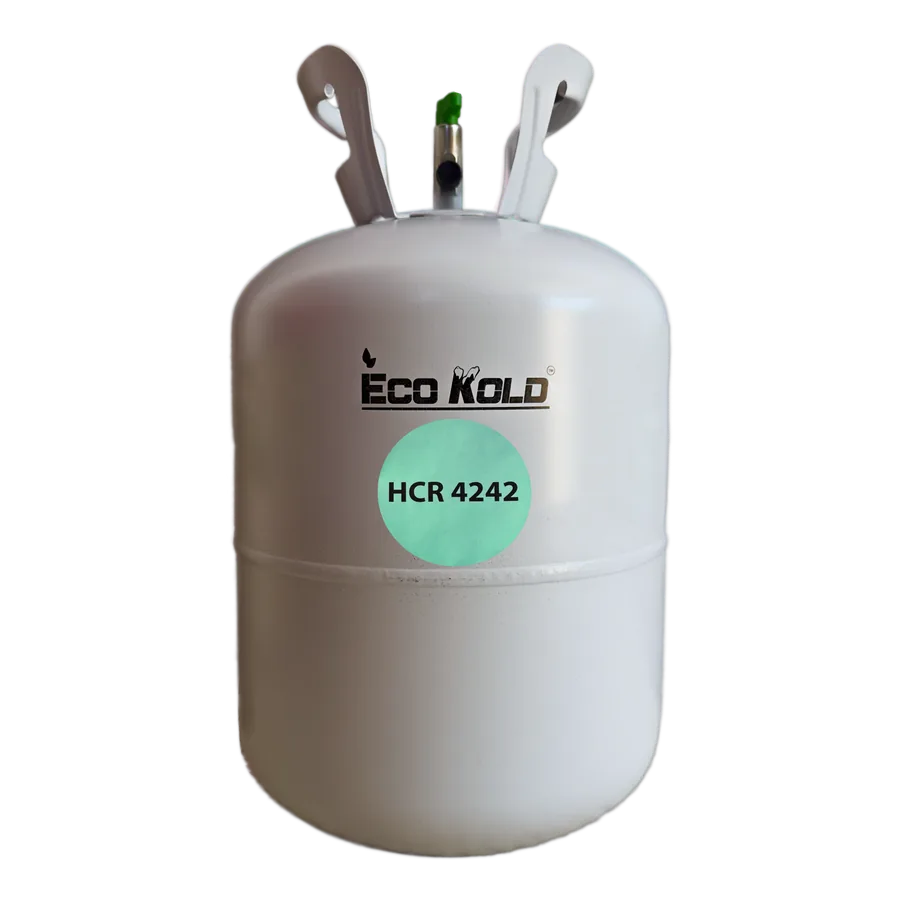
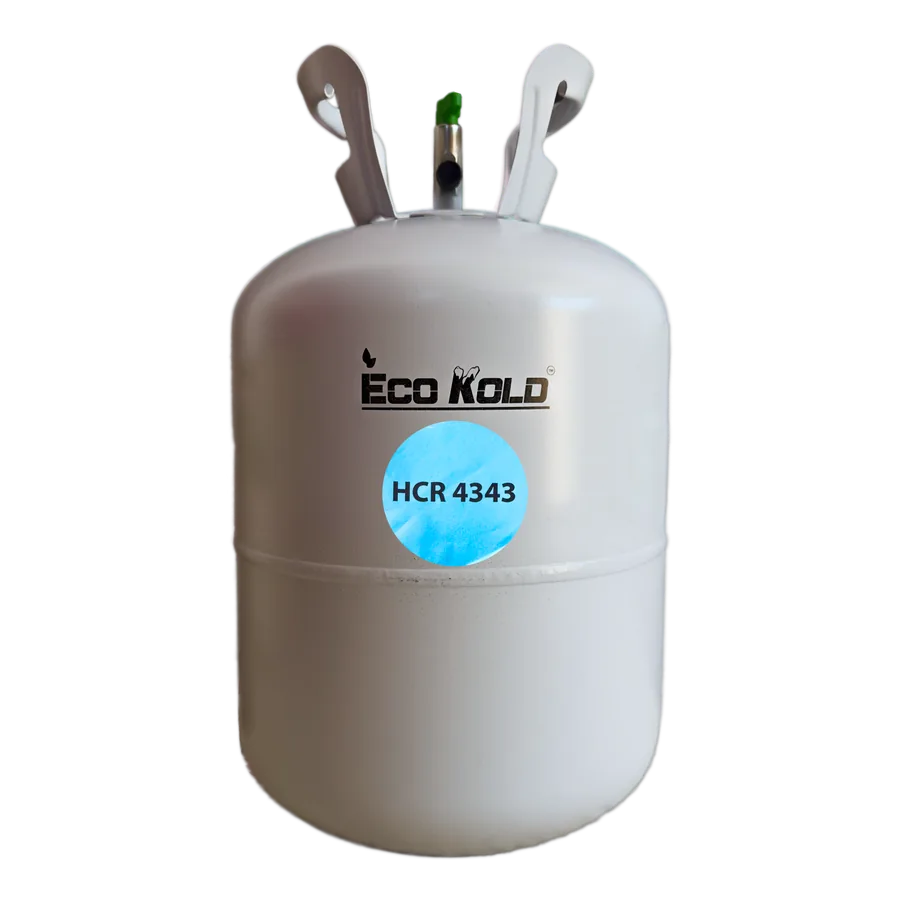
Side-by-side: every Eco Kold blend against the refrigerant it replaces.
Three comparison charts on one page: GWP, refrigerant charge, and operating pressure across the full Eco Kold line. Independent field measurement is underway; verified results will be published once cleared.
One chart per metric. All four blend pairs at the same scale.
Every chart below shows the same four blend pairs (HCR 4040 vs R-404A, HCR 4141 vs R-410A, HCR 4242 vs R-22, HCR 4343 vs R-134a) on a single x-axis. The visual ratio of HCR-to-legacy bar lengths is the comparison.
Global Warming Potential: the headline gap.
Every Eco Kold blend carries a GWP of <1. The synthetic refrigerants they replace range from 1,430 (R-134a) to 3,922 (R-404A). At the same scale, the HCR bars are visually invisible: that's the point.
GWP values sourced from the BHCR Refrigerant Replacement Comparison Chart, aligned with IPCC AR5 100-year GWP figures. See the full GWP background page for the math and the regulatory context.
Charge reduction: same heat moved, less material.
Hydrocarbon blends carry more cooling work per unit mass than HFCs, so an HCR system reaches equilibrium at a much lower charge weight. The 55–65% reduction range across the line is one of the reasons retrofits produce lower compressor work and lower kWh.
Charge ratios shown as percentage of the legacy refrigerant baseline: representative values across hydrocarbon retrofits. Absolute system-specific charge weights are part of every quote and listed on each product page.
Suction-side pressure: what the manifold gauge reads.
Eco Kold blends sit at lower equilibrium pressures than the HFCs they replace. The numbers below are the typical suction-side reading at the system's normal duty point. Lower pressure means less compressor work per cooling-ton-hour, and that's where the energy reduction comes from.
Pressure values are representative readings at each blend's typical duty point. See the full P/T reference for the saturated-pressure curves across the entire operating range.
Measured on real equipment, not estimated.
Energy-reduction numbers for refrigerant retrofits vary by site, equipment, and climate. Independent field measurement is underway; verified results will be published once cleared.
Additional installations are in documentation. Audit data on file; case-study publishing pending customer consent and writeup. See the case-study index →
Measured, not estimated.
Every energy-reduction number we publish comes from a third-party audit or a controlled before/after measurement on the same equipment, same thermostat setpoints. No simulation. No marketing math.
24-hour comparative audits
Audits log current and kWh on the AC's main circuit, before and after the retrofit, on consecutive same-weather days. Independent field measurement is underway; verified results will be published once cleared.
Same equipment, same setpoints
Audits run on the same evaporator, condenser, lineset, blower fan, and thermostat. The only variable that changes between the baseline and the retrofit is the refrigerant charge.
Pressure-curve match
Eco Kold blends are engineered to land on the same pressure profile as the legacy refrigerant. That's why the existing condenser and TXV/expansion valve don't need to be replaced. The energy reduction comes from a lighter charge moving the same heat.
Common questions about Eco Kold performance.
How the comparison data is sourced, what the numbers mean for a real retrofit, and what to expect at your facility.
Which Eco Kold blend replaces R-410A?
HCR 4141 is the drop-in replacement for R-410A and R-32 air-conditioning systems. It matches R-410A’s pressure curve so the existing condenser, evaporator, lineset, and expansion valve stay in place: only the refrigerant charge changes. See the HCR 4141 product page for specs.
How much energy can a hydrocarbon refrigerant retrofit save?
Eco Kold retrofits target up to 50% kWh reduction depending on the blend, the legacy refrigerant, and the equipment age. Independent field measurement is underway; verified results will be published once cleared.
What does GWP <1 actually mean compared to R-410A?
GWP (Global Warming Potential) is the warming effect of a gas relative to CO₂ over 100 years. Eco Kold blends carry a GWP of <1, the same as CO₂. R-410A’s GWP is 2,088, meaning 1 kg of vented R-410A traps 2,088× more heat than 1 kg of CO₂. The full math is on the low-GWP background page.
Do Eco Kold blends require equipment replacement?
No. Every Eco Kold blend is engineered as a drop-in retrofit for the synthetic refrigerant it replaces. The installation procedure is recovery, vacuum, then recharge by weight: the same sequence any certified HVAC technician performs for a standard refrigerant service call. No compressor, condenser, or expansion-valve change is needed.
Are these comparison numbers independently audited?
The GWP, charge weight, and operating pressure figures come from the BHCR engineering datasheets. Independent field measurement of energy reduction is underway; verified results will be published once cleared. Additional installation audits are in documentation; contact us for source data.
Have a system running on R-22, R-410A, R-404A, or R-134a?
Send us the equipment make, model, and current refrigerant. We'll match the right Eco Kold blend, quote pricing, and connect you with a certified installer in your region, usually within one business day.